top of page

4 weeks

spring '24

sketching

CAD modeling

woodworking

Four-Board Poplar Stool

With a 60" long plank of unfinished Poplar, I designed, modeled, processed, cut, and assembled a four-board stool. 

Final stool with white background- front view
Rough Prototypes
Table of Contents
rough prototypes
Rough Prototypes

To freely and quickly experiment with different designs, I created 1/4 scale stools out of foam core board.

Five foamcore quarter-scale prototypes of stools.
Sketches from different angles of foamcore model version 1.
Sketches from different angles of foamcore model version 2.

The unprocessed plank of poplar was 60" x 11" x 1".
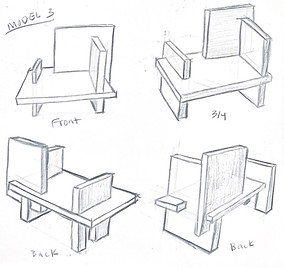
Sketches from different angles of foamcore model version 3.
Sketches from different angles of foamcore model version 4.
Sketches from different angles of foamcore model version 5.
SolidWorks models
SolidWorks Models

I measured features of the foam core models that worked well and adapted them to SolidWorks. I continued to adjust and iterate digitally. Below is an exploded view of the stool assembly.

Solidworks drawing of final stool exploded view

I wanted the design to feature a variety of joint types, including slip and dado, while also accounting for a consistent flow in the direction of grain, and a balance of negative space. I also ensured that there would be enough stability in the design by accounting for screw placement

Construction

I used a chop saw to get my planks to their proper size, then joined and planed the wood until it was the proper thickness and square. For individual pieces I used the bandsaw and router to cut internal grooves, and a chisel to create internal corners.
construction
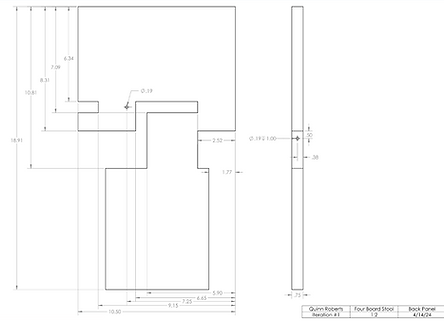
Solidworks drawing of dimensions of back panel
Poplar final back panel created using a joiner, planer, chopsaw, bandsaw, router, sander, and a chisel.
Solidworks drawing of dimensions of right panel
Poplar final right panel created using a joiner, planer, bandsaw, router, sander, and a chisel
Solidworks drawing of dimensions of seat panel
Poplar final seat panel created using a joiner, planer, bandsaw, router, sander, and a chisel
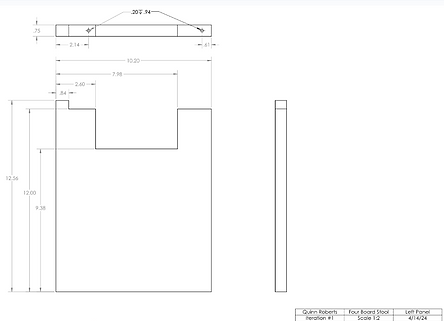
Solidworks drawing of dimensions of left panel
Poplar final left panel created using a joiner, planer, bandsaw, router, sander, and a chisel
Assembly

To assemble the panels, I drilled holes in the panels and attached panels with Robertson screws. I used the drill press to create plugs from contrasting Spanish Cedar, and used those to fill the screw holes and highlight the production process. I sawed off excess Spanish Cedar to lay flush to the Poplar.

assembly
Poplar stool assembled with screws- the screw holes are visible.
Poplar stool assembled with screws- the screw holes are plugged with Spanish Cedar.
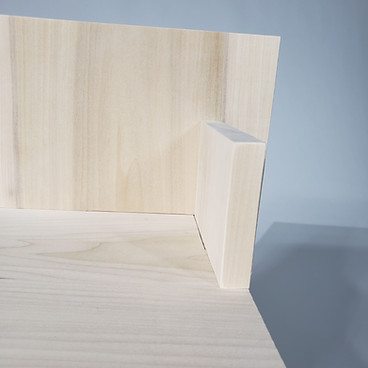
Poplar stool assembled with screws- the screw holes are plugged and sanded smooth.
finished stool pics

The stool backrest is 19" tall, with the seat 12.5" off the ground. I chose specific portions of the plank to be used in order to emphasize the grain flow and create a cohesive stool with a balance of negative space.

Final Stool

Final stool with white background- front view
Final stool with white background- back view
Final stool with white background- 3/4 back view
Final stool with white background- front lower view
Final stool with white background- side view
Final stool with white background- front detail view
Final stool with white background- front lower detailview
Final stool with white background- front lower detail view
Final stool with white background- front detail view
Final stool with white background- front view
bottom of page